Visions of the complex projective plane
I failed the first question of my graduate school qualifying exam. My professor asked me “what is your favorite symplectic manifold.” I said I liked $S^2$. “Don’t you want something higher dimensional?” Okay, lets go with $\RR^4$. “What about $\mathbb{CP}^2$?” $\mathbb{CP}^2$ it is.
$\mathbb{CP}^2$ is shorthand for the “complex projective plane”. As a set, $\mathbb{CP}^2$ is the space of nonzero vectors in $\CC^3$, where two vectors are identified if they are related by a complex scaling. Symbolically,
\[\mathbb{CP}^2 = \frac{\CC^3 - \{0\} } {\vec{z} \sim\lambda \vec{z} }\,\text{ for } \lambda \in \CC-\{0\}\]Many mathematician’s favorite space is $\mathbb{CP}^2$, and not always by choice. It’s ubiquitous in Complex geometry, symplectic geometry, and 4 dimensional topology. But what does it look like?
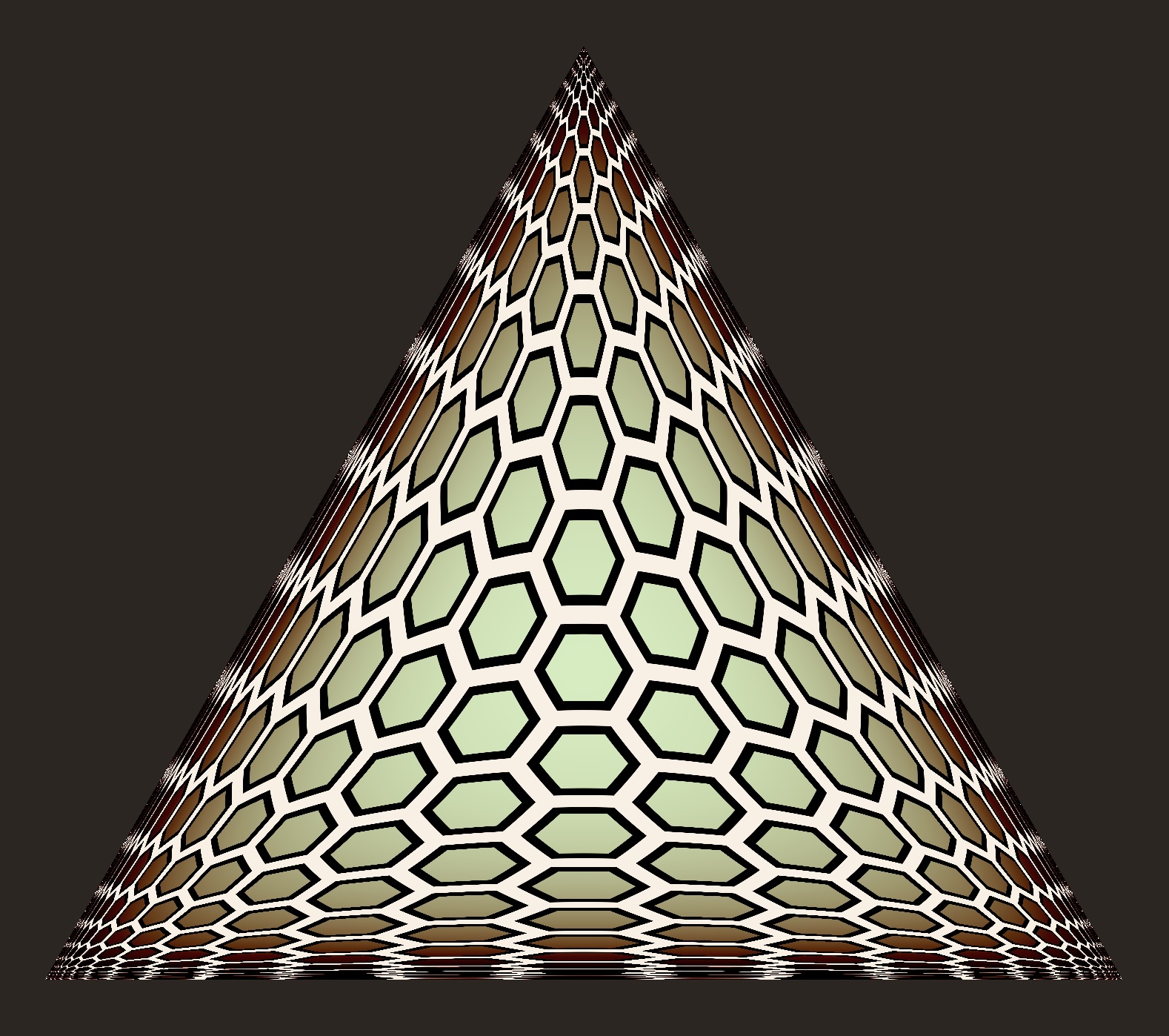
This semester, I set out to visualize the complex projective plane $\mathbb{CP}^2$. I like to draw $\mathbb{CP}^2$ as a triangle, representing its toric structure. I explain this picture here
Toric structure on the complex projective plane
Summary:
A point in the complex projective plane can be described by a triple of complex numbers, each described by a magnitude and a phase. Forgetting the phase defines a map from $\mathbb{CP}^2$ to a triangle, whose fibers are tori. Here is a collection of visualizations of this toric structure.
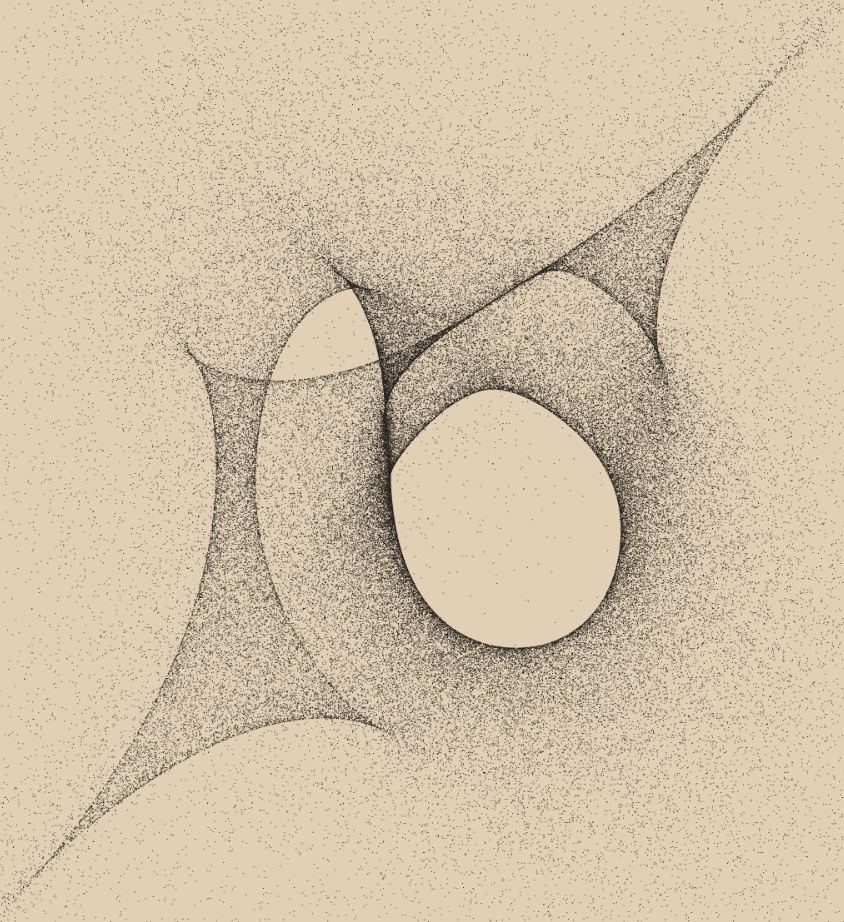
$\mathbb{CP}^2$ is as much a mathematical object as an arena for other mathematical objects. Algebraic plane curves naturally live in the projective plane. The zero locus of a homogenous polynomial of 3 variables defines a complex one dimensional subvariety of $\mathbb{CP}^2$, an algebraic curve. In this applet, I visualize the shadow of an algebraic curve under the toric projection. I do this by plotting random points on the curve, chosen uniformly with respect to the fubini-study metric, and projecting these points to the triangle.
Shadows of curves in $\mathbb{CP}^2$
Summary:
Explore shadows of complex algebraic curves in the complex projective plane.
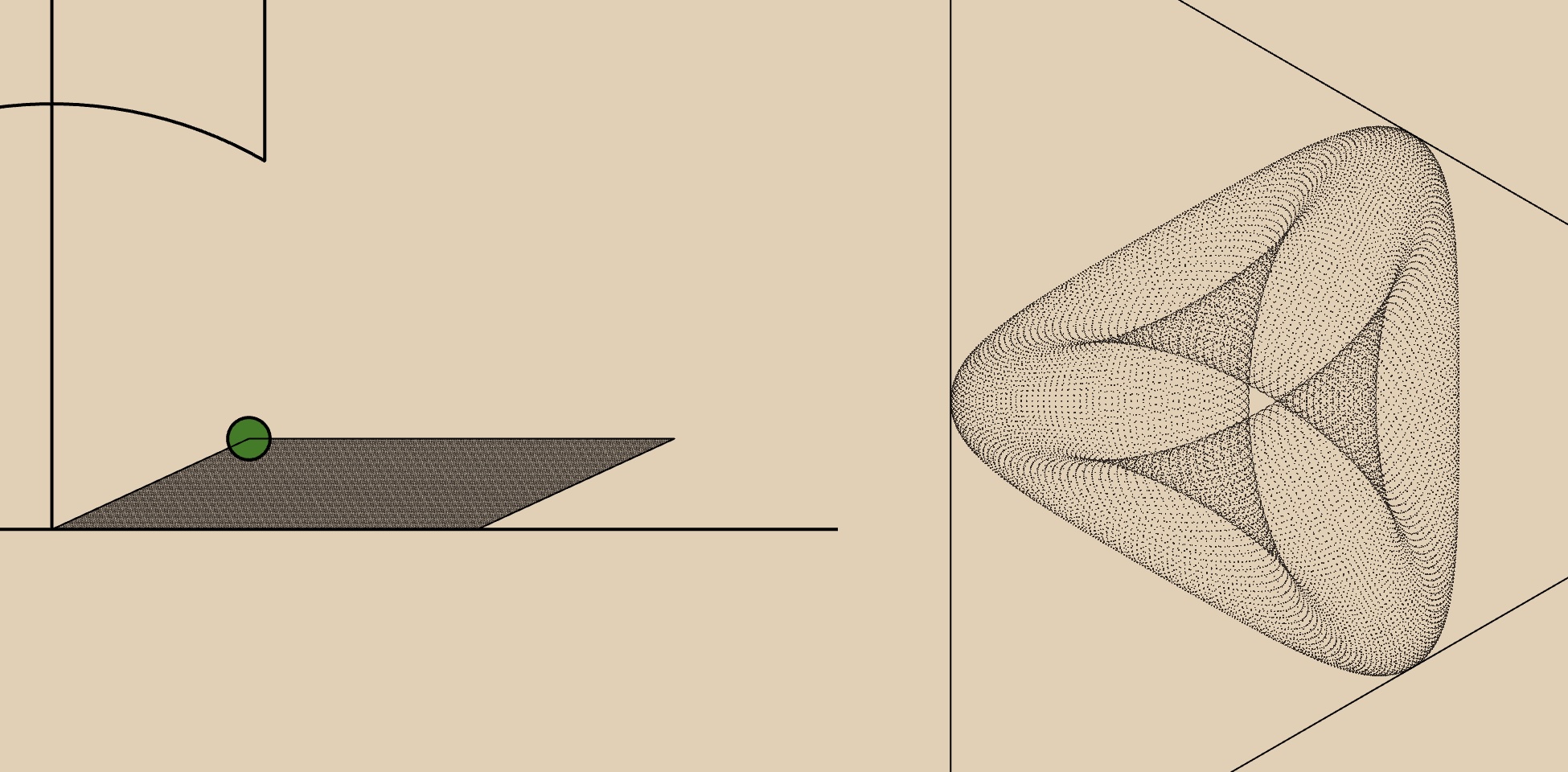
Instead of defining curves implicitly, we can define a map from a Riemann surface into $\mathbb{CP}^2$. In this applet, I map a complex torus into $\mathbb{CP}^2$ using theta functions. I use this to visualize the torsion points on an elliptic curve, which form a grid on the complex torus. I map these torsion points into $\mathbb{CP}^2$, then project those points onto the triangle.
Torsion points of elliptic curves
Summary:
Visualizes torsion points of an elliptic curve, as they sit inside of $\mathbb{CP}^2$.
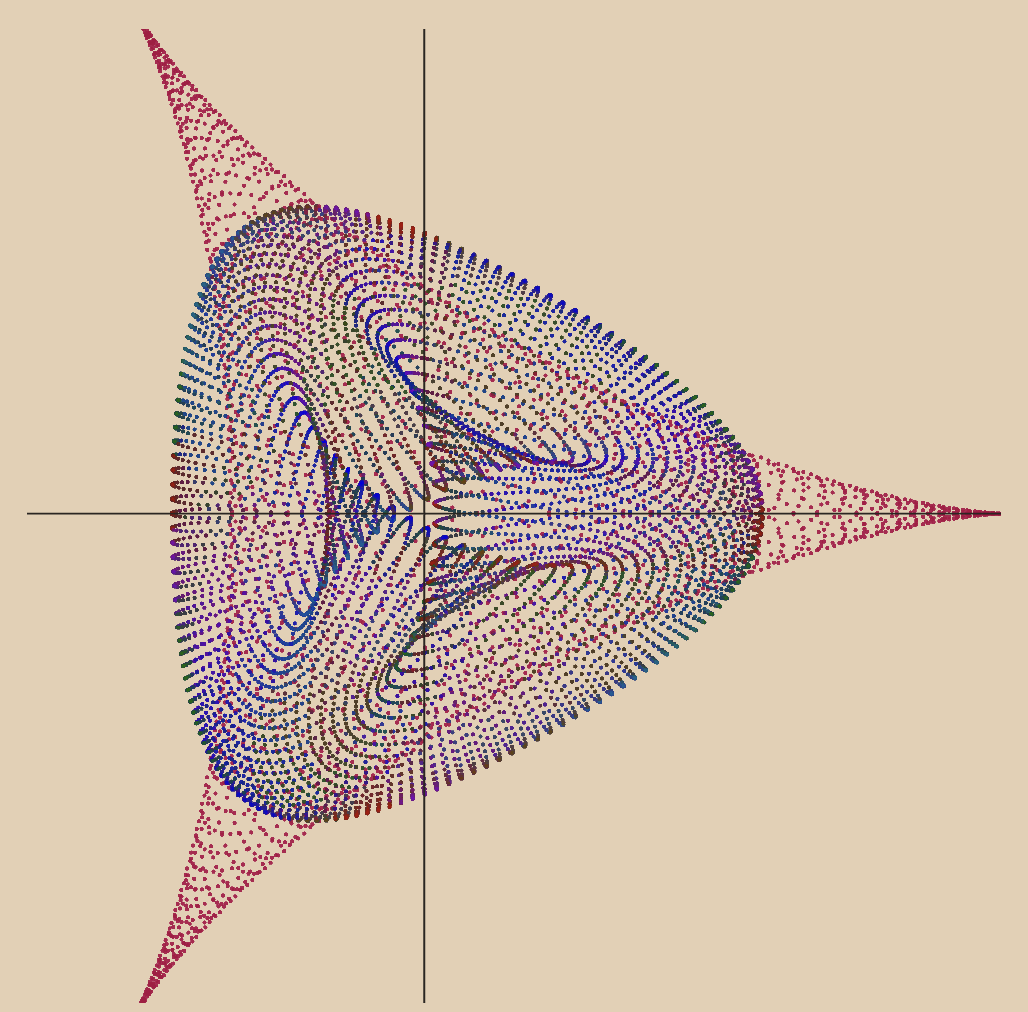
I showed these pictures around the trimester. Kate Stange pointed out these pictures of torsion points looked very similar to some generated by Duke, Ramon Garcia, and Lutz in The Graphic Nature of Gaussian Periods. This is mysterious, because elliptic curves have on the surface nothing to do with Gaussian periods. In my pursuit of understanding this better, I made a gaussian period visualizer.
Gaussian periods
Summary:
Gaussian periods are particular families of sums of roots of unity. This applet visualizes the set of values of gaussian periods.