Moduli spaces of polygons
Click, drag, and scroll dots on sphere to control polygon
Does not work on mobile! please play on desktop sorry
This applet shows the isomorphism between a polygon in $\mathbb{R}^3$ and a weighted collection of points on $\mathbb{CP}^1$. Thinking of $\mathbb{CP}^1$ as the unit sphere $S^2 \subset \mathbb{R}^3$, each point defines the direction vector of an edge of the polygon, and the weight defines the length of that edge. From the collection of edge vectors, we construct a chain. A Closed polygon is a chain ending at the origin, while an Abelian polygon is a chain ending on a specified plane.
We are interested in the moduli space of polygons with specified edge lengths up to their natural symmetry. The Polygon moduli space is the space of closed polygons with specified edge lengths modulo the $SO(3)$ rotation action. The Abelian polygon moduli space is the space of abelian polygons ending at the plane $z = \alpha$, modulo the $S^1$ action rotating around the $z$ axis. (They are called abelian polygons because this symmetry is abelian.) As the applet shows, the space of chains with specified lengths $\alpha_i$ is a product of spheres $\prod S^2$ with radii $\alpha_i$. To produce the desired moduli space, we apply a constraint then divide by the group action. The constraint is achieved by specifying the value of the moment map of the group action. The resulting moduli spaces are symplectic reductions
- The polygon moduli space is $\prod S^2 //_0\, SO(3) = \mu_{SO(3)}^{-1}(0)/SO(3)$
- The Abelian polygon moduli space is $\prod S^2 //_\alpha\, S^1 = \mu_{S^1}^{-1}(0)/S^1$
To apply the moment map constraint $\mu=0$ in the applet, I apply the reverse gradient flow by $\nabla \vert\mu\vert^2$. The “constraint strength” slider controls the step size of gradient descent.
Created as part of WISCON 2026
Input controls
Each dot on the left sphere controls a edge of the polygon on the right
- Double click to add/ remove dots
-
Scroll over dot to change the length of the associated edge
- Click and drag to rotate sphere and polygon.
- Scroll on right to zoom in and out of polygon.
- Hold shift and drag on right to pan polygon.
More Polygons
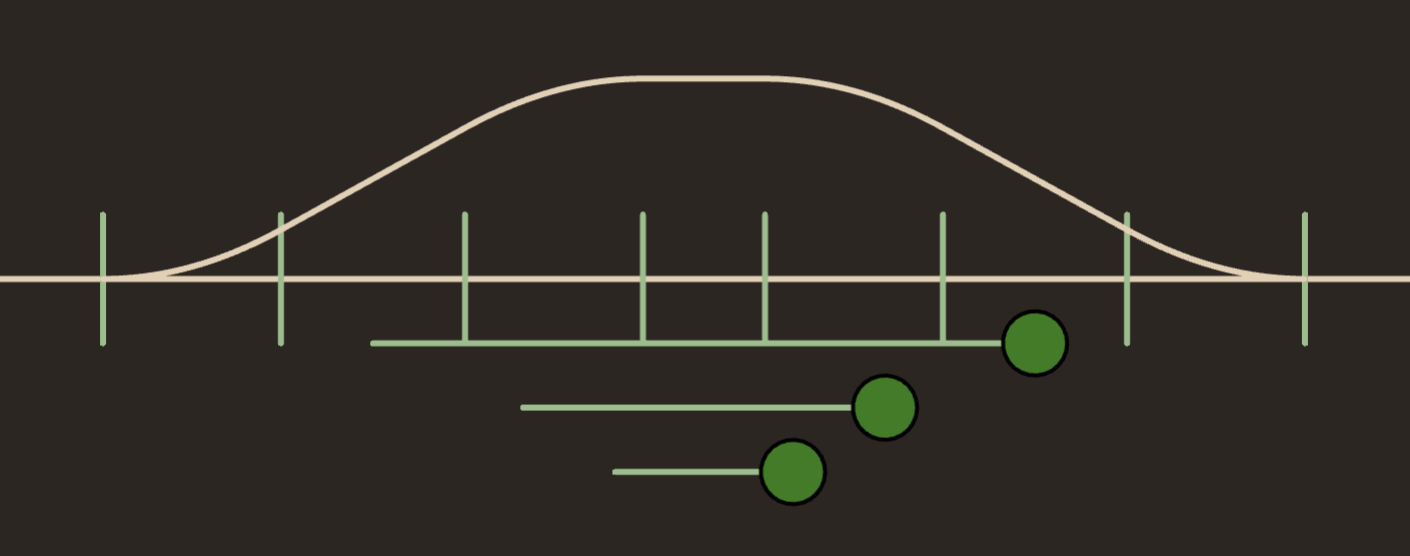
Duistermaat-Heckman measure
Program computing the volume measure of the abelian polygon space as a function of height of the plane. The sliders at the bottom control the lengths of the edges of the chain. The green ticks indicate the critical values of the diagonal $S^1$ moment map.